


Article by: Ryan Poole, National Exercise Physiology Lead
For decades, workplace health strategies have followed the same pattern: an employee gets injured, a claim is lodged, treatment begins and the organisation manages the consequences.
But what if we could identify the risk before the injury occurs?
Advances in AI-powered movement analysis are making that possible. We are entering an era of predictive workforce health where movement dysfunctions, physical limitations and emerging injury risks can be identified early and addressed before they impact employees.
The data hidden in human movement
Every day, employees perform thousands of movements that influence their risk of injury. Squatting, reaching, lifting, twisting and balancing all provide valuable information about an individual’s physical capacity and movement quality.
Historically, capturing and analysing this information across an entire workforce has been difficult, time-consuming and expensive.
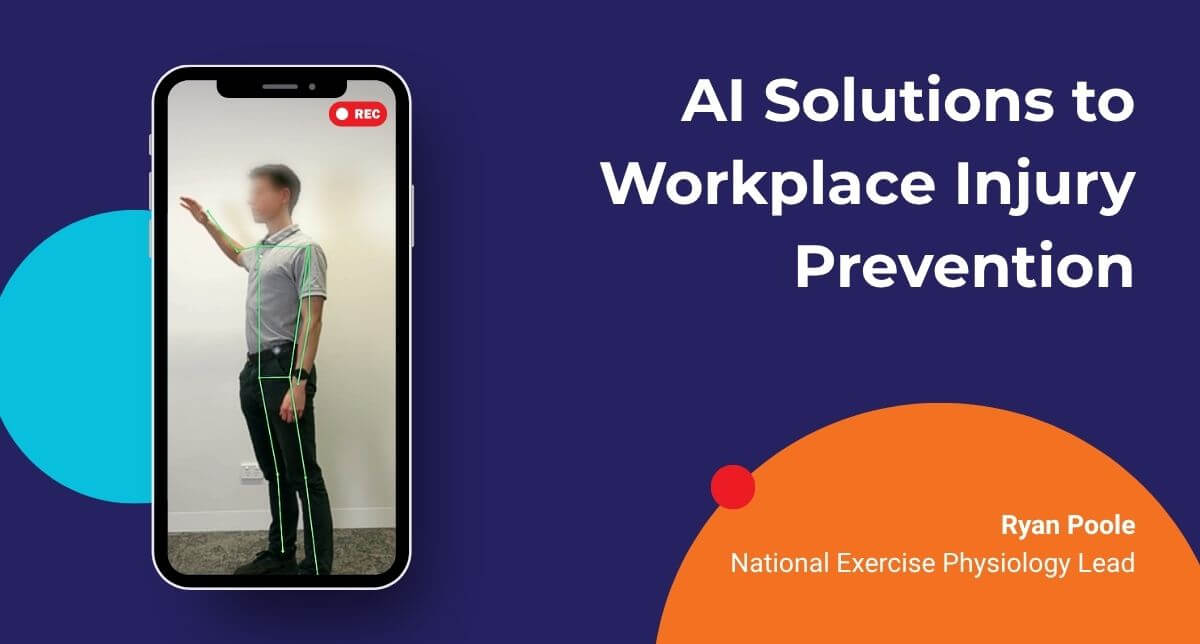
Advancements in computer vision have changed this. Solutions such as AIMOTION can now assess functional movement patterns without the need for wearable sensors, specialised laboratory equipment or in-person injury management specialist. Employees simply complete a series of guided movement screens while AI-powered tools capture detailed biomechanical data to automatically analyse movement quality, mobility, balance and symmetry.
The result is objective, measurable movement data collected consistently and efficiently. For many organisations, this provides something they have never had before: a population-level view of workforce movement health.
Shifting from lag indicators to risk identification
Most workplace health programs rely on lag indicators like injuries, claims, lost time incidents and absenteeism. By the time these metrics appear, the problem has already occurred.
Predictive screening enables organisations to focus on leading indicators instead. By identifying movement deficiencies, mobility restrictions and functional limitations early, employers can detect red flags that increase an individual’s likelihood of injury during everyday work tasks.
Rather than asking, “Who got injured this month?”, organisations can begin asking, “Who may be at risk right now, and what can we do about it?”
Turning data into personalised action
The true value of workforce movement screening is not simply identifying risk; it is knowing what to do next.
When screening data reveals specific movement limitations, targeted interventions can be implemented immediately. An employee demonstrating reduced shoulder mobility can receive a tailored mobility program. A worker showing poor squat mechanics can benefit from targeted movement coaching and strength development.
This creates a highly educational and personalised approach to workforce health that moves beyond generic wellbeing programs and addresses the exact physical demands employees face on the floor. Instead of treating everyone the same, organisations provide the right intervention to the right employee at the right time.
The organisational impact
While protecting employees is the primary objective, the systemic benefits of predictive screening are equally compelling.
Work-related musculoskeletal injuries remain one of the largest drivers of workers’ compensation costs globally, contributing heavily to lost productivity, absenteeism and workforce disruption. By identifying risk factors early and implementing targeted preventative strategies, organisations can:
- Reduce injury frequency and severity
- Lower workers’ compensation costs and premiums
- Decrease absenteeism and lost time
- Improve workforce resilience and physical capability
- Make safer, evidence-based decisions regarding role placement
The future of occupational health
The next evolution of workplace health and safety will not be built solely on incident reporting. It will be built on objective data.
Just as organisations use predictive analytics to monitor equipment performance and operational efficiency, workforce health is becoming increasingly measurable and actionable. AIMOTION is an innovative service that provides the framework to understand workforce capability in ways that were previously impossible.
The question is no longer whether we can measure movement health at scale. The question is whether your organisation can afford not to.
How is your organisation currently measuring physical injury risk?
Reach out to the team to discuss how predictive movement screening can fit into your safety strategy, or find out more about AIMOTION.